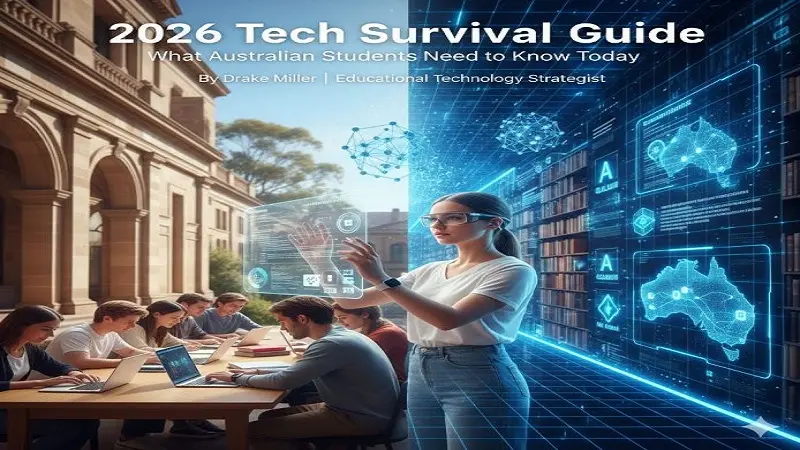
The transition into 2026 hasn’t just been a two-year jump; in my years tracking the shift in Australian education tech, it’s a generational shift. For high school and university students across Australia—from the lecture theatres of USYD and UniMelb to regional high schools—the academic landscape is being rewritten by silicon and software.
By 2026, the “novelty” of Artificial Intelligence (AI) will have worn off, replaced by deep, systemic integration into every facet of study and work. To stay competitive, students must look beyond current tools. In my work with educational institutions, I’ve seen that the students who succeed aren’t those with the most expensive gear, but those with the highest “Tech-Agility.”
Here are the defining tech trends shaping the Australian student experience in 2026 and how you can prepare today.
1. The Era of the “AI Co-Pilot” (Moving to Agentic AI)
By 2026, we have officially moved past the era of simply “asking a chatbot a question.” We have entered the age of Agentic AI. Unlike the early Large Language Models of 2023, these are autonomous systems that don’t just write text; they perform multi-step tasks.
Drake’s Insight: I’ve tested these agents in real-world academic workflows. Instead of using AI to summarize a PDF, students now use AI agents to manage entire research pipelines. An agent can cross-reference global databases, suggest a methodology based on Australian Bureau of Statistics (ABS) data, and even troubleshoot complex Python or C++ coding errors in real-time.
How to prepare: Stop treating AI as a shortcut. Master “Prompt Engineering 2.0″—the ability to direct AI through complex, multi-stage logical reasoning. In the Australian context, the Tertiary Education Quality and Standards Agency (TEQSA) has shifted focus toward “AI-assisted integrity,” meaning you must be able to explain how you used AI in your workflow.
2. Spatial Computing and the “Phygital” Classroom
With the maturation of hardware like the Apple Vision Pro and more affordable, high-performance competitors, 2026 has seen Spatial Computing become a standard in higher education. We are moving from 2D screens to immersive 3D environments, often referred to as “Phygital” (Physical + Digital) learning.
What it means for students: Architecture students in Brisbane or Adelaide no longer just look at blueprints; they walk through digital twins of their designs. Medical students perform virtual dissections with haptic feedback that mimics the resistance of human tissue. Even humanities students are affected, with history majors “visiting” 19th-century Sydney Cove in a reconstructed digital environment to analyze urban planning.
Drake’s Advice: Don’t wait for your uni to provide the headset. Familiarize yourself with AR/VR interfaces now. If you are in a technical or creative field, start exploring Unity or Blender. By 2027, 3D literacy will be as fundamental as knowing how to use Microsoft Word.
3. Hyper-Personalized Adaptive Learning
The traditional “one size fits all” lecture is officially a relic of the past. By 2026, Adaptive Learning Platforms have become the backbone of the Australian curriculum. These platforms use real-time data analytics to tailor content delivery to your specific cognitive pace.
The Human Element: While this helps, the sheer volume of personalized data can be overwhelming. In my observations of student performance trends, the jump in digital curriculum complexity often requires a human “bridge.” This is where professional academic support, such as Myassignmenthelp.services, becomes a vital safety net. Many students searching for the best assignment help Australia turn to expert guidance to stay aligned with evolving university standards while maintaining academic integrity.
4. Quantum Literacy: The New Frontier for AU Students
While full-scale quantum computers remain specialized, Quantum-as-a-Service (QaaS) is now accessible via the cloud for Australian university research. This is revolutionizing fields like cryptography, drug discovery, and climate modeling—critical areas for Australia’s 2030 sustainability goals.
Drake’s Insight: You don’t need to be a physicist, but you do need “Quantum Logic.” It represents a fundamental shift from binary logic ($0$ and $1$) to complex probabilities. Understanding how this tech disrupts cybersecurity is particularly crucial for future-focused business and IT students, especially those balancing technical modules alongside marketing theory and seeking structured marketing assignment help to manage strategic case studies effectively.
5. Green Tech and Circular Electronics
As Australia moves toward its 2030 emissions targets, the technology of 2026 is defined by “Sustainability by Design.” The “throwaway” culture of tech is being replaced by modularity and repairability, spurred by new right-to-repair legislation.
6. The Cybersecurity “Arms Race”
In 2026, the distinction between a real video and a “Deepfake” is virtually non-existent. AI-driven phishing attacks are now personalized based on your social media footprint. Consequently, cybersecurity is no longer a niche IT subject; it is a core life skill.
Drake’s Insight: “Information Verification” is now the most valuable skill in your arsenal. Academic integrity is monitored using advanced biometric analytics to ensure the person behind the keyboard is actually the student. Practice “Zero Trust” digital habits—use hardware security keys and learn to verify primary sources.
7. Hybrid 2.0: The Fluid Campus
The concept of “going to campus” or “going to the office” has become entirely fluid. Hybrid 2.0 involves holographic presence and asynchronous collaborative tools that make Australian time zones (AEST/AWST) less of a barrier to global collaboration.
What it means for students: You will likely be part of a global study group. Your ability to manage a project across three different time zones using tools like Notion, Trello, and advanced digital whiteboards is a prerequisite for both university success and future employment.
Conclusion: Bridging the Digital Divide
The technology of 2026 offers incredible opportunities, but it also raises the bar for academic excellence. Students are expected to produce higher-quality, data-backed work at a faster pace than ever before.
Whether you are seeking expert academic tutoring to master these new digital frontiers through Myassignmenthelp.services or building your own future-proof workstation, the key is to be proactive. The future isn’t something that happens to you; it’s something you build with the tools you choose today. Start mastering the “Agentic” world now, and you’ll find yourself leading the pack in the 2026 academic year.
Frequently Asked Questions
Q.1 Is using Agentic AI considered “cheating” in Australian universities?
As of 2026, the Tertiary Education Quality and Standards Agency (TEQSA) and most Australian universities have moved toward a “Workflow Transparency” model. Using AI is generally permitted if it is used for research, data analysis, or troubleshooting—provided you disclose its use. However, submitting AI-generated work as your own original thought is still a breach of academic integrity. Always check your specific course outline, as rules vary between “Human-Only” and “AI-Augmented” assignments.
Q.2 Do I need to buy an expensive VR headset for the “Phygital” classroom?
Not necessarily. While high-end devices like the Apple Vision Pro offer the most immersive experience, most Australian universities provide “Spatial Labs” equipped with the necessary hardware. For home use, more affordable mobile-tethered headsets are becoming the standard. If you are a student in a specialized field like Surgery or Engineering, your faculty may offer hardware grants or loaner programs.
Q.3 How can I protect my assignments from AI-driven “Deepfake” plagiarism?
In 2026, academic identity theft is a real threat. To protect your intellectual property, use “Digital Watermarking” tools and always save your draft history. Universities now use behavioral biometrics to verify that the writing style matches your previous work. If you find your work has been cloned, contact your university’s Academic Integrity Officer (AIO) immediately.
Q.4 Where can I find help if I’m overwhelmed by these new tech tools?
Transitioning to a high-tech academic environment is a steep learning curve. If you feel the digital curriculum is moving faster than you can keep up with, don’t hesitate to seek human-centric support. Myassignmenthelp.services specialize in helping students bridge the gap, providing the tutoring and structural guidance needed to master these complex 2026 digital standards.
About the Author: Drake Miller
Drake Miller is a leading educational technology strategist specializing in AI integration and digital literacy for Australian students. With over a decade of experience advising on pedagogical shifts, he focuses on helping students bridge the gap between academic theory and the rapidly evolving global workforce. See more