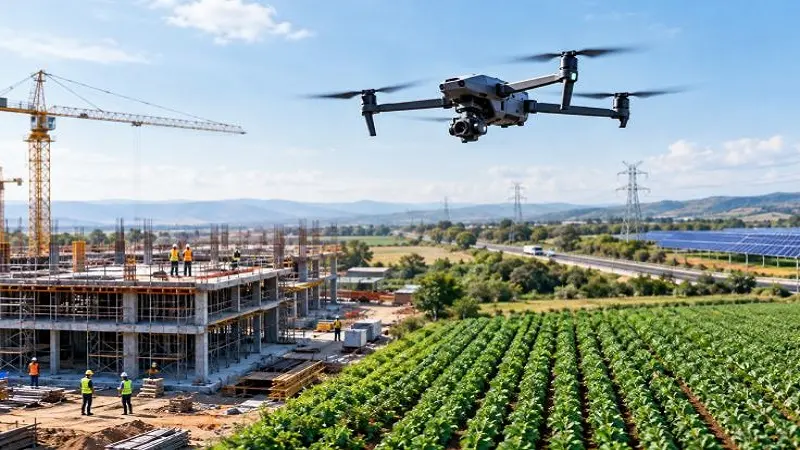
A while back, the idea of a drone doing real work would’ve raised eyebrows. Not anymore. Around Australia, companies in construction, farming, real estate, and emergency services rely on them daily. They trim costs, take people out of harm’s way, and pull in data that was basically impossible to get before.
Here’s what that actually looks like in the field!
Drones in Construction
Site Surveying and Progress Monitoring
Surveying land the traditional way eats up time and money. Fit a drone with LiDAR and photogrammetry software, though, and you can map that same block in a few hours. You walk away with an accurate 3D model before anyone breaks ground – which matters, because that’s the stage where changing your mind still costs next to nothing.
Then the build kicks off, and the drones keep pulling their weight. Regular flyovers give site managers a proper overhead look at how the schedule’s holding up. No harness, no ladder, no climbing the scaffolding just to check.
Safety and Aerial Inspections
Falls are still near the top of the list when it comes to injuries on site. Send a drone up instead of a person, and you take a lot of that risk off the table. Jobs that used to demand harnesses, scaffolding, or an elevated work platform can now be handled from the air. Fewer people in dangerous spots, fewer chances for something to go badly.
A number of big Australian infrastructure projects have already built drone inspections into their standard safety process. They’re logging fewer near-misses as a result.
Drones in Agriculture
Crop Monitoring and Precision Treatment
Aussie farms cover a lot of ground, and there’s hardly ever enough hands to work it all. A drone carrying multispectral and thermal cameras can sweep hundreds of hectares in a single flight. It picks up crop stress, pests, or irrigation problems long before you’d ever spot them yourself.
That same kit opens the door to precision spraying. Rather than blanketing an entire paddock, you hit only the patches that need attention. Less chemical, lower input costs, and soil that stays in better shape year on year.
Livestock and Yield Management
Mustering cattle across a sprawling station is grinding, slow work. A growing number of farmers now use drones to locate and move stock with far less effort. It doesn’t stop at the day-to-day, either. Predictive tools built on drone imagery help you estimate yields earlier in the season, so calls around storage, logistics, and pricing get a lot sharper.
Drones Across Other Industries
Infrastructure and Utilities
Power lines, telco towers, pipelines – all of it needs checking on the regular. Do that by hand, and you’re looking at dangerous, expensive work. Drones knock it over faster and cheaper, sending back high-resolution footage that engineers can go through from a desk.
Real Estate Marketing
Aerial photography has genuinely shifted how properties sell here. Drone footage shows buyers where a place sits, how big it really is, and what’s around it – things a ground-level shot just can’t get across. On rural and coastal listings especially, buyers now expect it. It stopped being a nice extra a while ago.
Search, Rescue, and Environmental Monitoring
Emergency crews across the country have brought drones into search and rescue. Thermal cameras help them find missing people in rough country faster than any ground team could. Conservation groups use the same gear to keep tabs on wildlife, spot illegal activity inside protected areas, and see how ecosystems recover after bushfires.
The Bigger Picture for Australian Businesses
Weighing it up for your own operation? Get the paperwork sorted early. Fly commercially and you’ll usually need a commercial drone licence in Australia, issued through CASA (the Civil Aviation Safety Authority), along with the right insurance.
The money you put into gear, training, and compliance tends to pay itself back fast once drone data starts standing in for days of manual work. The businesses that have already switched keep saying the same thing: better efficiency, safer sites, smarter decisions. So it’s less about whether drones belong in your operation. It’s how soon you can get them off the ground.