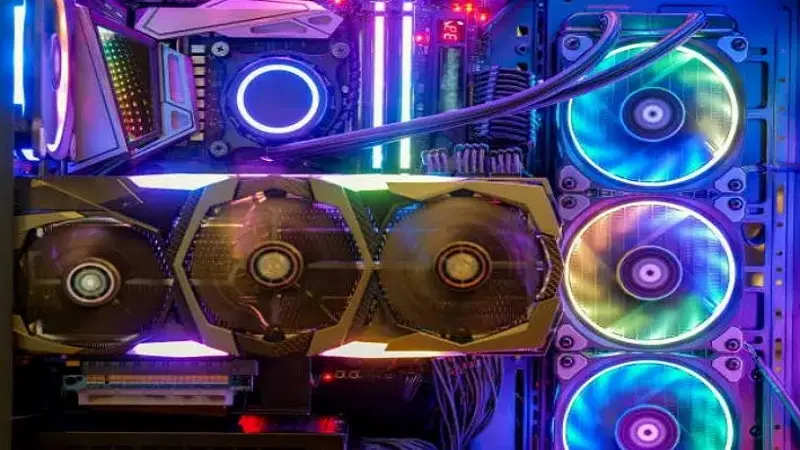
Modern mobile computing has reached unprecedented levels of processing power. However, cramming desktop-grade silicon into chassis less than an inch thick creates a massive physical dilemma.
As processors draw more wattage, their TDP (Thermal Design Power) generates immense heat within a severely confined surface area. If this thermal energy is not aggressively evacuated, the silicon quickly reaches its maximum safe operating temperature.
Why Modern CPUs and GPUs Hit the Thermal Wall
When pushing desktop-replacement laptops and external GPU (eGPU) enclosures to their computational limits, managing extreme thermal density becomes the primary bottleneck. Standard internal blowers often fail to provide sufficient pressure to evacuate the heat, leading to aggressive Thermal Throttling and degraded performance.
To combat this in custom high-end cooling pads and professional workstation docks, hardware engineers frequently integrate high-efficiency ACDCFAN systems. These solutions deliver precise PWM-controlled airflow to rapidly dissipate localized heat pockets without introducing severe mechanical noise.
Ultimately, thermal throttling is a self-preservation mechanism baked into the hardware’s microcode. The only way to bypass this limitation and sustain peak clock speeds is through superior external thermal management.
Active Cooling Mechanics: Beyond Built-in Laptop Blowers
The cooling architecture inside a standard high-performance laptop relies on miniaturized centrifugal blowers and copper heat pipes. While marvels of engineering, these components are bound by strict physical dimensions.
When placed under continuous, heavy computational loads, the internal cooling array becomes fully saturated. At this stage, pushing external air into the chassis becomes necessary, requiring an understanding of advanced aerodynamic metrics.
The Role of CFM and Static Pressure in Confined Enclosures
To design effective custom cooling pads or eGPU ventilation, engineers must balance two distinct aerodynamic properties:
- CFM (Cubic Feet per Minute):This measures the raw volume of air a fan can move in an open space. While high CFM is great for open-room ventilation, it struggles against physical resistance.
- Static Pressure:Measured in mmH2O, this is the aerodynamic force required to push air through restrictive barriers, such as densely packed aluminum heatsinks, chassis vents, and internal copper fins.
If an external cooling solution relies solely on high CFM without adequate static pressure, the air simply bounces off the bottom of the laptop chassis. A high-pressure system is strictly required to force cold ambient air through restrictive bottom intakes.
Upgrading the Airflow: DC vs. EC Fan Technologies in Custom Setups
The mechanical heart of any high-tier custom cooling dock is its fan motor. For decades, standard Direct Current (DC) fans were the default choice for PC hardware.
However, as the thermal requirements of workstation-grade laptops and massive eGPU enclosures scale up, engineers are looking toward more robust industrial topologies to manage the load.
PWM Speed Control and Acoustic Efficiency
Modern high-performance cooling arrays are increasingly adopting Electronically Commutated (EC) technology. This design offers a significant leap in both motor efficiency and acoustic profile.
- Precision PWM Regulation:EC fans utilize advanced microprocessors to read thermal sensors, adjusting their RPM seamlessly via Pulse-Width Modulation (PWM) rather than crude voltage stepping.
- Acoustic Stealth:By eliminating brush friction and operating strictly at the required speed, these motors drastically reduce the distracting mechanical whine common in cheap laptop cooling pads.
- Torque Delivery:The magnetic topology of an EC motor provides the high torque necessary to generate massive static pressure, effectively penetrating restricted eGPU grilles.
Key Takeaways
| Area | Key Takeaway | Impact/Data |
| Aerodynamics | Prioritize Static Pressure over raw CFM | Penetrates restrictive chassis vents |
| Motor Tech | Adopt EC fans with PWM control | Eliminates mechanical whine |
| Performance | Bypass internal blower saturation limits | Sustains peak clock speeds |
| Hardware | Prevent prolonged extreme heat exposure | Stops silicon electromigration |
Extending Hardware Lifespan Through Proactive Thermal Management
Investing in robust external cooling is not just an enthusiast pursuit for higher benchmark scores. For IT professionals and power users, it is a critical strategy for protecting expensive hardware investments.
Prolonged exposure to extreme heat physically degrades silicon and adjacent motherboard components, such as voltage regulator modules (VRMs) and capacitors.
Preventing Silicon Degradation in Professional Rigs
Proactive heat dissipation is not merely about sustaining temporary peak clock speeds; it is a fundamental engineering requirement for hardware longevity.
According to technical documentation on computer cooling dynamics and microprocessor reliability, maintaining operating temperatures well below the silicon’s maximum threshold is the most effective method for preventing long-term electromigration.
By utilizing high-static-pressure, intelligent cooling arrays, professionals can ensure absolute system stability over years of heavy rendering, compiling, or gaming. See more